BUas Data Science & AI students develop tools to boost short food supply chains
07/01/2026 - 14:06

- News
- Student work
Within the Short Chain cluster of the Circulaire Stromen – Next Level Logistics research project, three students from the BUas Applied Data Science & AI programme have started working as student assistants. Over a period of three months, each is developing their own digital tool. These tools are designed to make short food supply chains more manageable, logistically smarter and commercially stronger. The first working versions, known as Minimum Viable Products (MVPs), will be presented on 18 June during the CS-NLL Partner Event.
Three tools, three challenges
Short chains – in which food travels as directly as possible from producer to consumer – suffer from a lack of digital support. Data is often missing, supply and demand are difficult to align, and logistics and packaging planning frequently relies on intuition rather than data. The three student assistants are each tackling part of this challenge:
1. Automatic logistics data from imagery (Marin Chiosa)
Short chains rarely have access to structured logistics data, making efficient management almost impossible. Marin is developing a system that automatically converts photographs of food products, storage or transport into usable logistics data, without requiring any manual input from users. The aim is a working tool that takes an image as input and automatically outputs logistics data (including product type, quantity, condition and location).
2. A proactive AI chatbot for matching supply and demand (Daniil Sysenko)
Daniil is building an AI system that automatically matches producers' supply with demand and available transport or storage capacity, while negotiating price, timing and logistics on the supplier's behalf. The system aligns with the principles of the sharing economy: shared transport, shared storage and seamless payment. In short, Daniil is creating a working chatbot that identifies suitable demand and transport capacity based on available supply, proposes a match, and negotiates terms on behalf of the supplier.
3. Predictive tool for order volumes (Leon Kušić)
Leon is developing an AI model that predicts future order volumes based on historical order data from the short chain and the catering sector. This will enable producers and logistics partners to plan more effectively: less waste, more efficient packaging and smarter supply. Leon is working on a forecasting model that calculates future volumes per product or product combination based on historical orders, complete with an accessible dashboard for users.
Also: graduation research from TU Eindhoven by Jasmijn van Heck
Alongside the three BUas projects, Jasmijn is conducting graduation research at LCB as part of her bachelor's thesis at Eindhoven University of Technology. She is analysing historical orders from the Short Chain and quantifying relevant variables as input for AI models. Her work contributes directly to a better understanding of expected volumes and opportunities for logistics optimisation, providing valuable scientific underpinning for the ongoing tool development.
A flying start with an Experience Day in the region
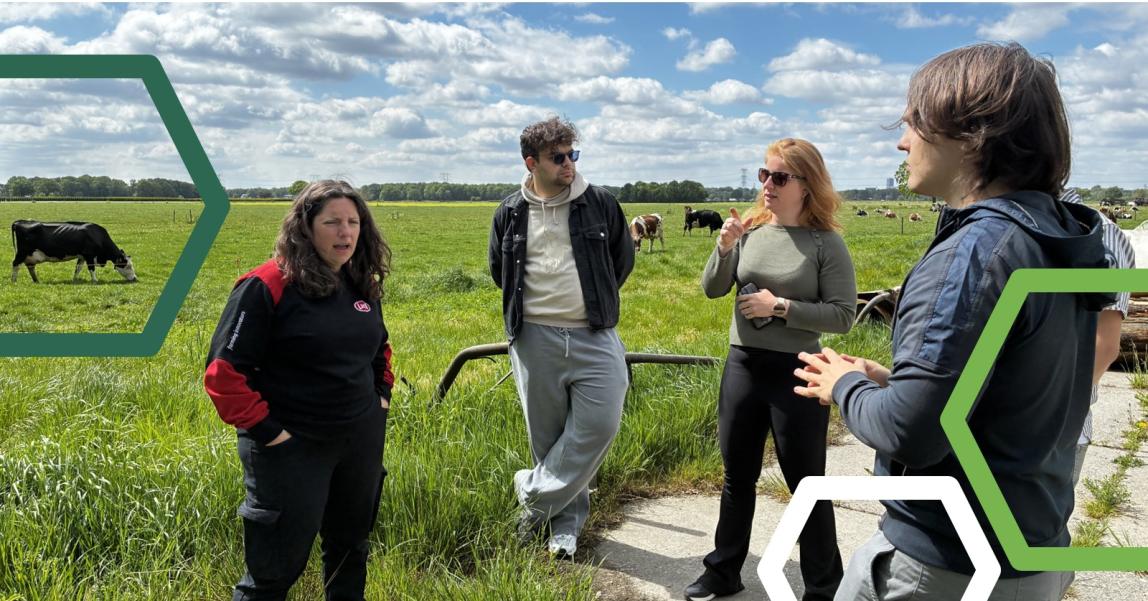
To give the students direct insight into the purpose of their work, project coordinator Alexander van Weelden organised an 'Experience Day' in the region on Monday 11 May. The group visited:
- De Walhoeve in Goirle: a farm with beef cattle and its own farm shop.
- De Dobbelhoeve in Udenhout: an organic dairy farm where milk from more than 100 cows is processed on-site into (barista) milk and yoghurt.
- The central hub of the Brabants Streekgoed cooperative and The Food Directors: the logistical heart of the regional short chain.
These visits gave the students practical, first-hand insight into the challenges of the short chain: how a producer operates in practice, what data is available, and where the main logistical bottlenecks lie. This knowledge forms an essential foundation for the tools they are developing.
What's next: further development from September
The project does not end after the demonstration in June. From September, the three tools will be further developed. Several routes are being explored for this, including internships and/or graduation assignments for students, the deployment of internal and external expertise from the academy or through external hires for further technical development, and a collaboration focused on linking and integrating existing platforms and/or tools developed in other clusters. The three MVPs to be presented on 18 June are therefore not the endpoint, but the starting signal for a broader digital transformation of the Short Chain.
Funding
The Circulaire Stromen – Next Level Logistics project is made possible in part by Logistics Community Brabant, Midpoint Brabant, Breda University of Applied Sciences, TNO and Eindhoven University of Technology, with subsidies from the Province of Noord-Brabant, Klimaatfonds Tilburg and Regio Deal Midden-Brabant. The Regio Deal Midden-Brabant is an initiative of Midpoint Brabant, Tilburg University, Fontys, Yonder and the Ministries of Economic Affairs and Climate Policy (EZK), Infrastructure and Water Management (I&W), and the Interior and Kingdom Relations (BZK).