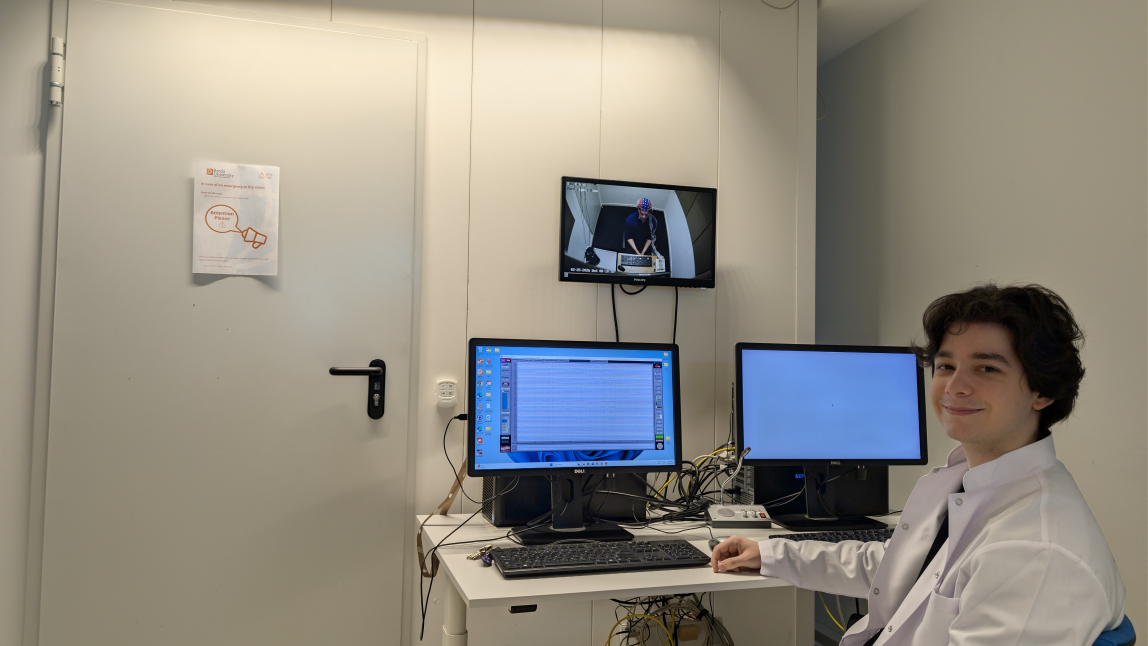
Thought-controlled tech with AI: Interview with student Ionuț-Alberto Boțoroga

Thought-controlled tech with AI: Interview with student Ionuț-Alberto Boțoroga

02/27/2026 - 09:43

Ionuț-Alberto Boțoroga, a fast-track student in his final year of the Applied Data Science & AI programme at BUas, is pushing the boundaries of neuroscience and behavioural research. As a Research Assistant at the BUas Experience Lab, he designs and builds systems for behavioural research and uses AI and data science to analyse experimental data and brain activity.
Data Science & AI
  • Stories
  • Student work

Where are you from, and what brought you to the ADSAI programme at BUas? 

Ionuț-Alberto: 'I'm from Romania, I'm 22 years old. My main interests lie in neuroscience and human-computer interaction, although I’m also passionate about the cosmos and space exploration. I was drawn to BUas because of its project-based, flexible approach to learning. I prefer learning by doing, and the ADSAI programme’s emphasis on hands-on projects rather than traditional exams suited me perfectly.' 

Can you describe the project that you are working on?  

Ionuț-Alberto: 'I’m currently working on my graduation project at the BUas Experience Lab. The project involves using EEG headsets to record brain activity while participants imagine various movements. The goal is to classify these imagined movements into six categories, such as moving left, right, up, or down, and translate them into commands for a robotic arm. Essentially, the participant can control the arm purely through thought, without any physical movement. This extends previous research, which typically focuses on fewer movement classes and only the motor cortex, by also incorporating activity from the prefrontal and occipital regions of the brain.' 

Join the experiment: https://docs.google.com/forms/d/e/1FAIpQLSfrOuBJ6C85BHvE9L5yX4zv4Q1QUjhJgNvC85a9TtPZz0j5JQ/viewform?pli=1  

What does the process of this project look like? 

Ionuț-Alberto: 'The process started with a literature review to understand existing approaches. I noticed that most research focused on four movement classes, which only allowed control on a two-dimensional plane. I wanted to extend this to a three-dimensional space and include more classes by activating additional brain regions.’ 

‘Next, I designed the experiment: where to place the EEG sensors, how to stimulate the prefrontal and occipital cortices, and how to ensure reliable data collection. I recruited participants from a variety of backgrounds, collected the EEG data, and now I’m in the process of analysing it and training AI models to predict imagined movements in real time. The ultimate goal is to control the robotic arm at our BUas AI Makerspace accurately enough to play chess just through thought.' 

What was the most surprising thing you discovered along the way? 

Ionuț-Alberto: 'I was surprised by how deeply neuroscience and AI intersect. It’s not just coding; you have to think critically about how to design experiments, interpret biological signals, and match them to machine learning architectures. Understanding the “why” behind the data is just as important as developing the AI models.' 

What are you most proud of? 

Ionuț-Alberto: 'I’m proud that I’ve been able to design and implement a complex neuroscience-AI project almost independently, understanding how to apply the right data to the right architecture. It’s a reminder that AI and data science aren’t just technical skills, they’re about thinking strategically, creatively, and scientifically.' 

Where do you see yourself after graduating? 

Ionuț-Alberto ‘I’m interested in specialising in BCI and Neuro-AI consultancy, with the aim of enabling people with disabilities to interact with the world in a more intuitive way. In the longer term, I’m also fascinated by space exploration and sustainable data centres in space, combining AI and neuroscience with a vision for broader technological and environmental impact.' 

Connect with Ionuț-Alberto on LinkedIn: https://www.linkedin.com/in/ionut-alberto-botoroga/