Victor Oorthuis on developing practical AI solutions for real-world healthcare
03/04/2026 - 13:50

- Stories
- Student work
Can you tell us a bit about your background and how you chose Applied Data Science & AI?
Victor: ‘I’m originally from Haarlem. When I was looking at different study programmes, there were only a few focused specifically on Data Science and AI. I felt that Breda University of Applied Sciences offered the strongest option.’
‘Before choosing this path, I didn’t have a very clear idea of what I wanted to do. But I’ve always been interested in Formula 1 and gaming. In Formula 1, teams rely heavily on sensor data for performance optimisation and race strategy. In gaming, AI plays a major role in development and gameplay mechanics. I realised that studying Applied Data Science & AI could open doors in those kinds of industries. I decided to give it a year, and it turned out to be a great fit.’
What was the focus of your project?
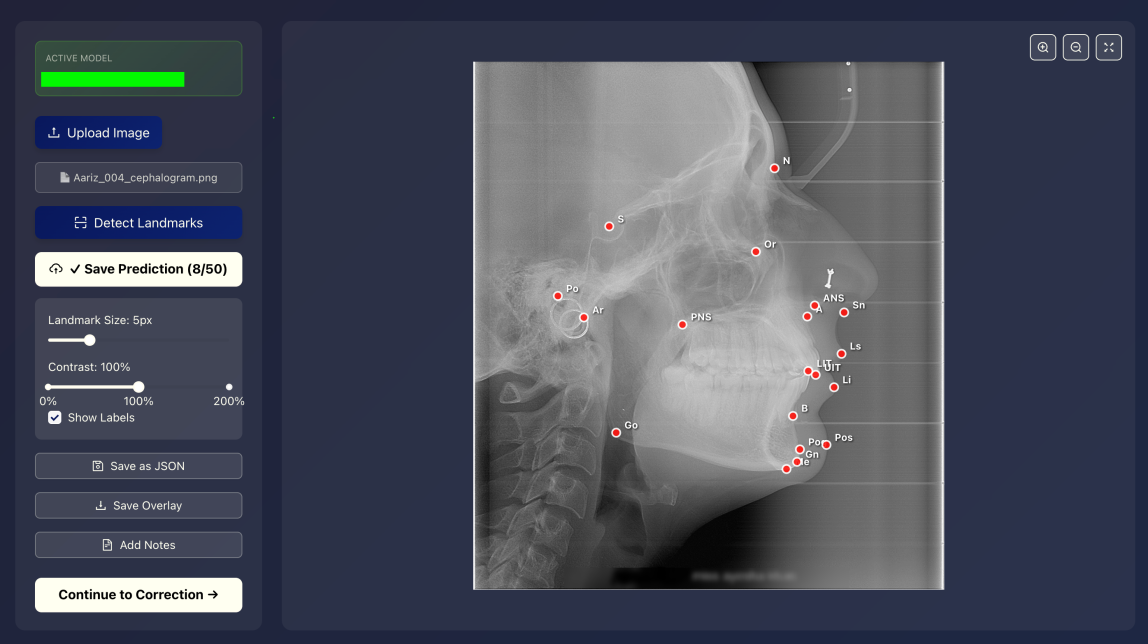
Victor: ‘The project centred on automating the annotation of lateral skull X-rays used by orthodontists. Traditionally, orthodontists manually mark specific anatomical landmarks on an X-ray, for example, just below the nose or along the jawline. These landmarks are defined in the literature and are used to calculate angles and distances that indicate things like overbite or jaw growth.’
‘The challenge is that manual annotation varies between practitioners. A junior orthodontist may mark points slightly differently from a senior one. The idea was to use AI to predict these landmarks automatically, making the process more consistent and time-efficient.’
‘However, we identified an additional issue: demographic bias. Many existing AI models are trained primarily on European or Asian datasets. Our client, based in South Africa, works with a highly diverse population. Models trained elsewhere did not perform equally well on this demographic. Our goal was therefore to build an application and AI model that could be trained, and retrained, on South African data to improve fairness and accuracy.’
How was the project structured, and what was your specific role?
Victor: ‘We worked in a team of five. My main responsibility was the front-end development and translating the model’s outputs into a usable application.’
‘One of our core deliverables was a web application where users could upload an X-ray image and receive predicted landmark positions. But we didn’t want to stop there. I focused on developing features that added real value for the end user.’
‘For example, we built movable landmarks. If the model’s prediction was slightly off, the orthodontist could manually adjust the point. We also implemented a fully manual annotation mode, allowing users to select and place landmarks themselves. Importantly, those manual annotations could then be stored as new training data for retraining the model.’
‘Another feature involved implementing standard orthodontic analyses from the literature, such as Steiner analysis, so the system could automatically calculate clinically relevant angles and distances once the landmarks were placed. That required diving into academic literature and validating our interpretation with the client.’
How did you collaborate with the client?
Victor: ‘We had regular feedback sessions, roughly every two weeks. That was essential, especially because we didn’t have domain knowledge in orthodontics. It would have been easy to spend weeks building something that ultimately wasn’t useful.’
‘Instead, I would develop a feature, present it, and immediately validate whether it met their needs. That iterative process worked very well.’
‘One of the challenges was timing. Sometimes we had to wait for feedback or for new data to arrive. Since we were working as a team of five, delays could temporarily block progress. But overall, the collaboration was very positive, and the client was actively engaged.’
What were the main challenges you encountered?
Victor: ‘A major challenge was the lack of domain knowledge. We had to thoroughly research how orthodontists perform their analyses and what measurements are considered standard. That meant studying academic literature and confirming our findings with the client.’
‘At the same time, that was also one of the most interesting parts. You’re not just building a technical solution, you’re learning how another profession works and translating that into software.’
‘Another challenge was ensuring the system could support retraining on South African data. Initially, we worked with European and Asian datasets, as those were more readily available. Later, the client used our annotation tool to label their own images, creating a new dataset tailored to their demographic context.’
Is the solution currently being used?
Victor: ‘Yes, it has already been used to annotate data for further model training. The client also intends to continue researching whether this type of solution can genuinely improve equality and reduce bias in orthodontic diagnostics.’
‘I’m not fully up to date on their long-term implementation plans, but the tool is definitely being used as part of ongoing research.’
You’re currently on placement at Rijkswaterstaat. How does that compare to this project?
Victor: ‘I’m currently doing my work placement at Rijkswaterstaat, working within a dedicated AI trainee team. We’re developing an anomaly detection system for a lock, analysing technical data to detect deviations.’
‘In the orthodontics project, I focused mainly on front-end development and business value. While I really enjoyed translating technical output into something useful for the client, I don’t necessarily see myself specialising purely in front-end work.’
‘What I enjoy most during my studies is exploring different aspects of AI, computer vision, anomaly detection, model development. I like the variation and am still discovering which direction suits me best.’
Connect with Victor Oorthuis on LinkedIn:
https://www.linkedin.com/in/victor-oorthuis-3b12612a6/